Dr. Nguyen: I am Khanh Nguyen, a pediatric cardiac surgeon from Mount Sinai. This is our second mission to Vietnam Hue Central Hospital. We were here about two years ago and now we are back. We are very impressed with the progress they made over the last two years. The heart center has been moved to a new building with great facilities. So we, for the next, I guess, week or so we’re going to be performing about 15 operations, and hopefully, we are going to work with the local surgeons and we will be able to learn from each other. We also try to exchange ideas and things, and hopefully, we will continue this cooperation in the future.
We are doing an operation this morning, a repair of a rheumatic mitral valve in a 24 year-old patient. The surgery is now ongoing and Dr. Adams, I am sure that he is working very hard on fixing this valve. Let’s take a look. We can see the number of people in this room trying to observe and learn from this operation.
We can see from the video camera that they are fixing the loop for the posterior leaflet on the mitral valve using a piece of pericardium, and this is a fairly common technique for repairing rheumatic valvular disease.
Dr. Adams: Can you see it Khanh?
Dr. Nguyen: Very well from your camera.
Dr. Adams: You see it’s an early sort of rheumatic, with a very shortened anterior and posterior leaflet., So, I am going to replace the posterior, I am going to put a big patch in the posterior leaflet, and in the anterior leaflet, I am going to cut all the cords out and replace them with three or four Gortex chords
Dr. Nguyen: The Chords are all shrunken.
Dr. Adams: We’re about half done. We’re going to be done here, it going pretty good, and I’m pretty confident it’s going to work. So I just have to finish sewing this patch in and I’ll do one commisurotamy , and I’ll put three Gortex Chords in, but the valve’s a good size so I’m not worried about stenosis. Should be done, should be out of here in and hour and a half or something, off bypass at least so you can start next door.
Dr. Nguyen: We have Teresa here, our super OR nurse. She has been with us for many, many missions from day one and she is such an important member of the team. I guess the mission would not be possible without her. No Matter what they say
Teresa: Thank you.
Gideon: How do you feel about the mission?
Teresa: Ah, it’s good. It’s a great experience and it’s helping all these kids here getting better.
Dr. Nguyen: Yeah, that is the main thing. You know we’re here for the babies, for the children, and that is our reward. Every time we fix a baby, we say this is why we are here. But, I think that the food also is pretty good, right?
Teresa: Yeah, excellent.
Dr. Nguyen: I guess we’re just too busy working. We should have some time looking around. Look at this beautiful place.
Teresa: Well, there are days that we finish early, there are days that we finish very late and it depends on how many cases we are doing per day.
Dr. Nguyen: This is the fourth day we’re starting, our 10th case this morning. The plan is to finish perhaps 15 cases; by Thursday, we should be finishing like 15, and in fact, the mission we’re equipped to do maybe just 15 cases because all the equipment that we brought over will be enough to use for 15 cases.
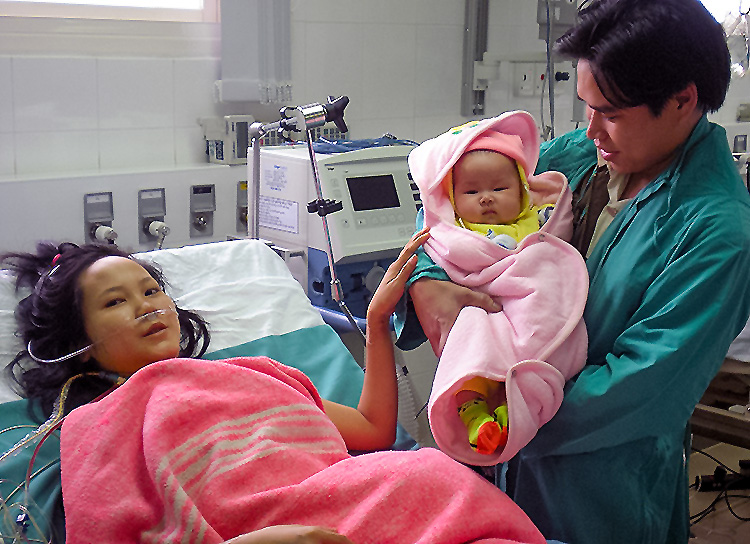
So, I am standing here in front of the ICU. All the children, after open-heart surgery will come back here for recovery, and this I believe looks like a 12-bed unit with a fully equipped ICU. Let’s take a look at some of the post-op patients. These patients, they are all fresh post-op. They are either day 1 or day 2 from surgery, and you can see some of them actually doing quite well, already extubated, and they are going to be moved to a second unit down the hall there to get ready for the next patient.
You can see the equipment in the ICU are very modern. We have a very large team of ICU nurses. You can see basically one nurse per patient.
Male: She’s just got everything.
Male 2: Did she smile yet?
Dr. Nguyen: She looks much happier this morning.
Nurse: She’s waving.
There is a lot of family waiting around. It really is like a mob scene, you know they’re just running and asking for things, and even family with the children who are supposed to have surgery, they came to me why is it we can make a decision for them and asking if I can have the child done, you know. It actually is very hard because they’ve been here for many months waiting; some of them, hoping to have surgery done on their child, but you know it is impossible for us to take care of everyone there.
I guess sometimes it is pretty much like a family affair, and I have this chance to bring some of my children with me and to have them exposed to a very different environment, seeing family with sick children waiting, just to kind of see the struggle they have to go through, so they maybe grow up with more appreciation for what they have back in the states, but I think it has been a tremendous experience for everyone here including my children.
Last mission I had my older son. He volunteered to be here with the team and he was helping around doing pretty much everything and he found that very, very rewarding. So this time, my little son also came and he has been working with the other children handing out candies and helping out.
Gideon: How old are you?
Kevin: I am 12 years old.
Gideon: Is this your first time to Vietnam?
Kevin: No, this is my second. Last time I went was when I was in third grade. I think I was 9 or 8 years old.
Dr. Nguyen: You had a great time. Didn’t you?
Kevin: But I feel like this time I went, it was more like important, like sentimentally.
Terry: Why is that?
Kevin: Oh, because I got to see my dad like, operate and stuff. I got to hear some of the stories the patients told and it was more meaningful than my last trip.
Dr. Nguyen: I think that some of them are here.
Dr. Adams: This girl is always getting a massage every time I come around. She’s always getting a backrub or something.
Male 2: She likes her back rubbed.
Dr. Adams: She likes getting a massage. Doesn’t she?
Dr. Nguyen: She still has some pain.
Dr. Adams: Well, you look good.
Dr. Nguyen: Is she the rheumatic?
Dr. Adams: No this is the first one we did. This is the one that had the, remember we were going to put the anterior chords and then we put in posterior chords. This was a congenital case. She is not feeling good. Ask her how she’s doing.
Dr. Nguyen: In the chest it hurts. We will get her something for pain.
Dr. Adams: Tell me about the breakdown of patients. How did you decide what we are going to do? I mean how do you decide between neonates and young adults and adults?
Dr. Nguyen: I think in a large program you usually have a choice of just doing neonatal. Certainly, it is a more challenging type of patient than you have who, you know the type of surgery is very different the switches and the Norwood but I think what I am doing right now, I am just kind of doing everything. We are doing congenital in adults too. The group of patients that we have seen, the neonates, most that we have seen here I think never had anything attempted to see the condition that they have, like the one that we did today, the TGA that had the restrictive ASD. We had to do a septectomy and that is a really big deal in the states, we would perform the chest operation right here. Unfortunately, I do not think they have the ability to perform that kind of complex operation here yet. The neonatal operation here is still much, you know, we need to train people to do that kind of surgery.
Dr. Adams: Let’s have a look over here at one of these patients. Who’s in the corner over here?
Dr. Nguyen: We have done a few Tetralogy of Fallot repair with very small babies. I think this size baby, they are also trying to learn how to do them and to do them well. Even though I think 80% of the patients here that we are seeing have this type of diagnosis. The smaller ones usually do not get those and they wait for them to get older, and by then, they tend to be much more difficult to take care of.
Dr. Adams So tell me what it is like to come back to the hospital you were born in and lead a team doing heart surgery.
Dr. Nguyen: That was really something, I think that it is kind of a neat feeling, almost like surreal. When I was walking through with Gideon this morning through the old hospital and I said, well this is where I was born, it was great and having the team come back here and help the children, I think that is a great experience.
Dr. Adams: That is the most incredible thing for me to get to come here. I did not know you were actually born in this city, in this hospital when I was coming. It is just amazing.
Dr. Nguyen: I think I stayed here for a few years. My family, I think, my mother’s family are actually very well known here. My uncle was actually Director of this hospital.
Dr. Adams: That is amazing. One thing that has been so impressive to me is this building, and how really sophisticated it is. It is really a dynamite hospital.
Dr. Nguyen: When we were here two years ago, it was not like this. This is completely a brand new building; so much progress has been made. It is incredible. We also have the other building, the general surgical building, and it is incredible; the size of the floor, and the size of the wards. You see patients stacked in next to each other. It is incredible.
Dr. Adams: It is always amazing when you start these older things, I had some experience once before in a program in China. How rapid the progress is once everybody sort of gets interested and motivated. Even though you are only here for a week or two, two or three times, but I think there is a lot of momentum. The early momentum is great from visits like this.
Dr. Nguyen: I am sure that next time you come here, there is going to be another level probably.
Dr. Adams: Tell me about what your goal would be if you are going to, what do you think our department should be trying to do. If we could just write our own ticket, what should we be thinking about trying to do?
Dr. Nguyen: I think this place has so much potential, and I think it is a good thing if you can help them to get to that level to be the center here in South Asia and providing the treatment for children with congenital heart disease and even transplantation that will be great and that will the main place for people to come for congenital heart disease.
Dr. Adams: One thing that I saw that was so fascinating, because we get to do all these valves together in these kids. One, there is a lot of synergy between pediatrics and adults in valve reconstruction, but the other thing is how much good you can do, I mean these four valves we just did, these are four tough valves and they all had pristine results. I really think that, that to me is one of the great opportunities in developing countries, because if you look even in Vietnam or China, not neonates, but the kids get very good surgery. It is actually, you know, this valve reconstruction is a frontier in these countries for these rheumatic patients.
Dr. Nguyen: I believe so, and you see so much pathology here and the clinical material just is mind boggling, the number of patients waiting with this pathology to be treated. It is just amazing.
Dr. Adams: I think that is to me one of the most exciting things about the opportunity here. I spent about an hour talking to, training doctors today showing them videos and the interest in this stuff is just unbelievable. I really think that this is one of the things that really interests me about a program like this is everybody is so focused on, on trying a lot.