

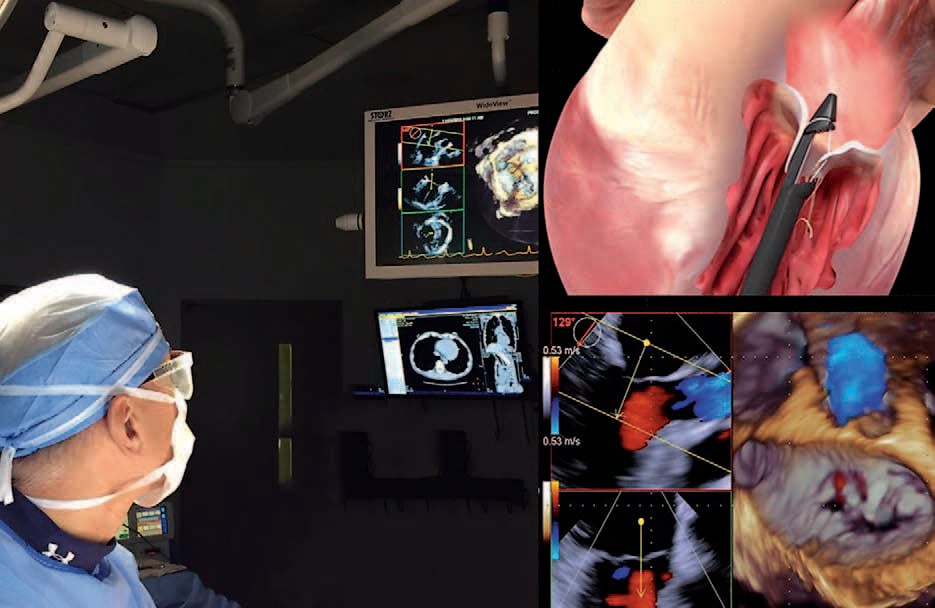
Narrator: Phillips live 3-D TEE on the IE33 combines the 3-D power of X Matrix and the clarity of pure wave crystals to provide exceptional image quality on a fully functional transesophageal transducer, the X72T.
Dr. David Adams: In the field of valve repair, echocardiography is the tool that really makes it happen. It is important for assessment of the lesions, it is important to plan your operation and it is important to look at the success of your procedure.
Dr. Gregory Fischer: It gives us live 3-D images which are amazing quality. The 2-D quality from the Matrix T, clearly it is a step up from other products.
Narrator: Phillips exclusive live 3-D transesophageal echo offers an easier, faster way to obtain more information.
Dr. Fischer: What really surprised me the most was how easy it is to acquire images with the 3-D technique.
Narrator: TEE exams performed with Phillips live 3-D echo provide clear details of cardiac morphology and function, facilitating treatment planning.
Dr. Adams: I think that all of us, whether from the anesthesia, cardiac surgery and frankly all of the rest of the staff, have really been impressed by the ability to look at the valve before we open up and understand the pathology of the lesion and frankly predict the repair before we do anything.
Narrator: Live 3-D TEE imaging provides views never seen before including the surgeon’s view of the mitral valve.
Dr. Adams: A distinct advantage of the real time 3-D technology versus traditional 2 dimensional echocardiography is the ability to look at the closure line in the loaded ventricle in a way we only could before with the atrium open and the ventricle filled with saline.
Dr. Adams: I think the exciting thing I have seen with 3-D echo is the image is so clear it is almost as if you are doing a valve analysis in the operating room. Better definition of the lesions is going to let the surgeon give the patient a true, informed consent because the surgeon can now look at the picture and say – yes, I have repaired this lesion set – and this is what your chances are of getting a repair.
Narrator: In the operating room, it is essential to understand quantitatively left ventricular function and the accurate morphology of the mitral valve.
Dr. Fischer: The quantification package allows us to truly make measurements that can make it very clear cut what type of pathologies are present and can aid echocardiographers in making that decision to which surgeon the patient should be referred to.