It is a pleasure to be back and to continue the discussion that we started last year talking about quality improvement in valvular disease. I changed my title slightly just to talk some more about mitral valve disease and where I think we need to go.
The topic we brought up last year is gaining momentum. Now it is in the lay press. I wanted to highlight this article that Bernadine Healey wrote in US News a few months ago where she was talking about first the Lasker Award, which most of you know was awarded to Alain Carpentier and Albert Starr for the creation of prosthetic heart valves. But she posed this question in the article, replace or repair – that is the question and it is the single most critical one for patients facing cardiac valve surgery. The irony is that Carpentier went on to find a way not to replace the leaking mitral valve. Surgical reconstruction spares the natural valve and the outcome is vastly better. Unfortunately, thousands of patients suitable for repair are still having their valves removed; missing out on what might be Carpentier’s greater contribution particularly if you have a mitral problem.
We do not need to debate whether valve repair is better but I thought I would just show you the 2007 literature on it. This was a meta-analysis looking at 26 or 27 different series’ for all the different types of etiology of valve disease and I just highlighted again for you in yellow all the ones that favor valve repair. So if you look at survival in the literature, all of them favor valve repair regardless frankly of etiology and of course it also favors valve repair in terms of freedom from thromboembolism. So it is not just mortality, it is also thromboembolism.
I think it is interesting again that we do not need to talk about degenerative disease. I picked two papers that talked about more complex sub groups. How about re-operation after a failed repair? Here is a paper from the Cleveland Clinic looking at the survival if you have your mitral valve re-repaired as opposed to replaced. So even in that complex sub group, it is worth it and the same holds true for endocarditis. Even in patients with endocarditis, this very sick sub group, look at the difference in your operative mortality and latent mortality both significantly improve when you have mitral valve repair versus mitral valve replacement, and that led Ken Zehr from Pittsburg to write in his commentary on this paper in the Annals, “To offer our patients the best long term results, mitral valve surgery in the setting of endocarditis should be approached with a full armamentarium of mitral valve repair techniques and often requires the most creativity that we can muster. Infection should not be used as an excuse to perform an easy mitral valve replacement.”
So the three things I wanted to review today are what I call the mitral valve quandary. The first one is why is mitral valve replacement so common? Well, I would submit that mitral valve replacement is safe, it is feasible by all heart surgeons, it is very effective for solving AV valve regurgitation, and it is usually a simple procedure. Mitral valve repair on the other hand is also very safe. It is very feasible particularly when it is done by mitral valve experts. It is very effective and it is often complicated. Bob already hinted to the issue of volume and quality of mitral valve replacement.
I wanted to show you this paper by Gammie. The first thing we should talk about is the operative mortality and of course as your mitral valve volume goes up in the STS database, your mortality decreases. So it is not just your repair rate which also improves and the highest volume centers of course have repair rates that are almost double what the low volume centers are but the operative mortality is also different. And that is the snapshot this year from the STS. So here is the 2005 and 2006 data from the executive summary that was released earlier this year in the spring and what you can see again; mitral valve repair hovers around 50% and about 2.5 to 3% change over the last year, too slow for patients. Too many patients are still getting isolated mitral valve replacement. What is the issue? Most heart surgeons perform less than 12 mitral valve operations per year; less than one per month.
England is tackling this. They are going to be the first country where the Public Health Service is going to say no. We are going to regulate mitral surgery. This is a paper I showed last year but it has gained momentum and it is actually at the regulatory side now in the British Healthcare System where they are going to have limits. They are going to say mitral valve surgeons have to perform a certain number of cases per year at hospitals as well because it is really a multi-disciplinary team that takes care of these patients to get the outcomes, and I predict that is going to be the future here too.
I want to show you a case to highlight the first concept which is why replacements are done so frequently. Here is a patient I met about five months ago. He is 53 years old, he is asymptomatic, he has severe mitral regurgitation, normal LV size and function, and he was operated on and actually it shows you Bob how tough reference center definition is. He was operated on in a high volume center. I met him here four weeks later. He has had a minimally invasive mitral valve operation. He is in atrial fibrillation with a large pleural effusion, and the original center where he was operated on does not want to do a re-operation. I am going to condense a four-hour operation for you into 40 seconds. Here is the mistake. Too much tension in the posterior leaflet and the failure to address excess tissue in one of the segments of the valve. This is a complicated operation. You need to carefully take out the old ring. You are going to have to really reconstruct the posterior leaflet correctly which requires detaching all of it from the annulus. The supporting frame around the valve now has to be narrowed because you are missing tissue. Then you need to put the whole valve back together again. This patient also needs a modified ring to really fit his unusual annulus and here is a proper result with a good closure line, and a competent valve, and a postoperative echo with a long line of symmetric closure.
To paraphrase Coach Parcells, I love this quote. I heard him say it once, “Do not tell me about the pain or delivery, just show me the baby.” I know you as cardiologists do not really care if I tell how hard it is to do mitral valve repair but I am going to try one more time. I borrowed this picture from Dr. Sabiston’s book. It is now edited by Frank Sellke.
Here is a picture of a mitral valve replacement. You see, you cut the anterior leaflet out and then you put these 12 or 14 pledgeted simple sutures in, you pass them through a sewing ring on this valve, and you tie it down. Now I am going to submit to you, anybody in this room, if you let me run the bypass machine and I will expose the valve for you; if you give me four months, I could teach you how to do the rest of it. That is mitral valve replacement.
How about mitral valve repair? I am sure everybody here knows that P2 prolapse of the middle scallop of your posterior leaflet is the most simple degenerative mitral valve lesion and the most common. I want to show you some pictures from our upcoming book that I have had the privilege of writing with Professor Carpentier about the simplest lesion in mitral valve repair and remember the picture of mitral valve replacement. So you can have limited tissue; you treat with chordal transfer or you could treat that with triangular resection. You can have extensive prolapse that you treat with quadrangular resection or angular compression, or you could have extensive prolapse where you need to also add sliding plasty to cover the defect. Then you have the more complex type of P2 prolapse where you may have a hypoplastic indentation and you need to close the indentation and do sliding plasty; or the most complex sub group where you have hypoplastic leaflets on both sides and that requires some sort of Z plasty to get a closured surface. That is the simplest lesion in mitral valve repair.
Mitral valve repair is complex and that is why the guidelines talk about reference centers. I hope next year, Bob or I, one of us can get up and talk about how we are moving toward defining the reference center because it should be obvious looking at these pictures that we need to.
How about current issues with referral? I am just going to highlight a few for you. We talked last year about etiology of degenerative disease and I challenge everyone to start to think about whether your patient had Barlow’s or fibroelastic deficiency. We have written a few reviews about this. I will show you these pictures. This is from one we published in Seminars in Thoracic and Cardiovascular surgery this year. Just to remind you; the Barlow’s patient has a giant valve, thick billowing leaflets, often calcification in the annulus, usually the posterior leaflet is displaced onto the atrial wall compared to fibroelastic deficiency; smaller valves, single chordal ruptures, usually single segment involvement, very different echo pictures, and very different surgical pictures. Barlow’s valves with giant prolapsing leaflets, very tall multi-segment disease versus the typical patient with fibroelastic deficiency with single segments that can be very thick and enlarged, in particularly the prolapsing segment but the rest of the valve often is normal. Very different diseases and very different surgical implications. This paper is impressive; Current Opinion in Cardiology, where we tried to summarize how to match etiology and surgical experience and if you look fibroelastic deficiency and simple posterolateral prolapse and remember the pictures I showed you, it is probable most experienced cardiac surgeons will repair that and it is certain a reference mitral surgeon will.
If you have anterior bileaflet involvement but it is single segment, I think it becomes possible that you will get a valve repair by an experienced heart surgeon still certain in a reference center. And with complex forms of Barlow’s disease, it is unlikely an experienced cardiac surgeon will be able to repair the valve and almost certain a reference surgeon will. So again it starts with differentiation and when you do differentiate valves and they go to reference centers, we showed that two years ago, and this is one of the papers that has gotten a lot of attention in our literature, which was 100% repair rate for the most complex sub group where you have giant bileaflet prolapse. So it can be done. It is a matter of matching the pathology with the expertise of the center.
I want to throw my own 2 cents worth in about watchful waiting. I have my own interpretation of Rosenhek and Serrano’s data and I just wanted to remind you thinking about etiology that most of these I will submit, many of these patients with flailed leaflets have fibroelastic deficiency. You noticed that the mean age is 55. It is seven or eight years younger than Serrano’s series and the flailed leaflets actually were not doing quite as well and the patients that had prolapse or mid systolic murmurs. Actually you can follow longer, and frankly that is how I counsel patients today. I think older patients that have prolapse from ruptured chordae are going to have less success with a long term interval of watchful waiting versus patients that have bileaflet prolapse and mid systolic murmurs. I think it is more likely those patients will be followed longer. It also shows you, I think in the future in our medical followup studies that we need to think about differentiating the disease and the lesion. Bob has already talked about this paper from Mirabel where they talked about the characteristics of symptomatic patients denied surgery emphasizing again that age and LV ejection fraction are probably over emphasized and not justified according to our current knowledge. So again, I think it is important when patients that are symptomatic with mitral regurgitation, they are sent to centers that have specific expertise in providing counseling for them. I also wanted to show you this paper published this year in the Canadian Journal of Cardiology from Toledano and what they did was they surveyed a broad spectrum of cardiologists in Canada, both university doctors as well as physicians in private centers. I just want to show you these two data points.
Lets look at the asymptomatic patient first and I want to show you that in the asymptomatic group, they are asking when should we refer the patient for surgery and what you can see is that 31% of the cardiologists, and there was not much difference by the way between community and university cardiologists; about a third of the cardiologists wanted to wait till the ejection fraction was below 50%. 2.8% said that they will wait before 40% and 7.5% said that they are going to wait for symptoms to develop no matter what the ejection fraction fell to. If we shift to patients that were Class II, you can see the numbers changed a little bit but not dramatically.
Still if you are Class II last year in Canada, you either had to develop further symptoms or have your ejection fraction drop below 50% to be referred for surgery and the conclusion here was that compliance with published guidelines for mitral regurgitation was actually very poor among Canadian cardiologists. So it is not just surgeons. I think the cardiology community has to recognize that we are not doing a good enough job meeting guideline therapy.
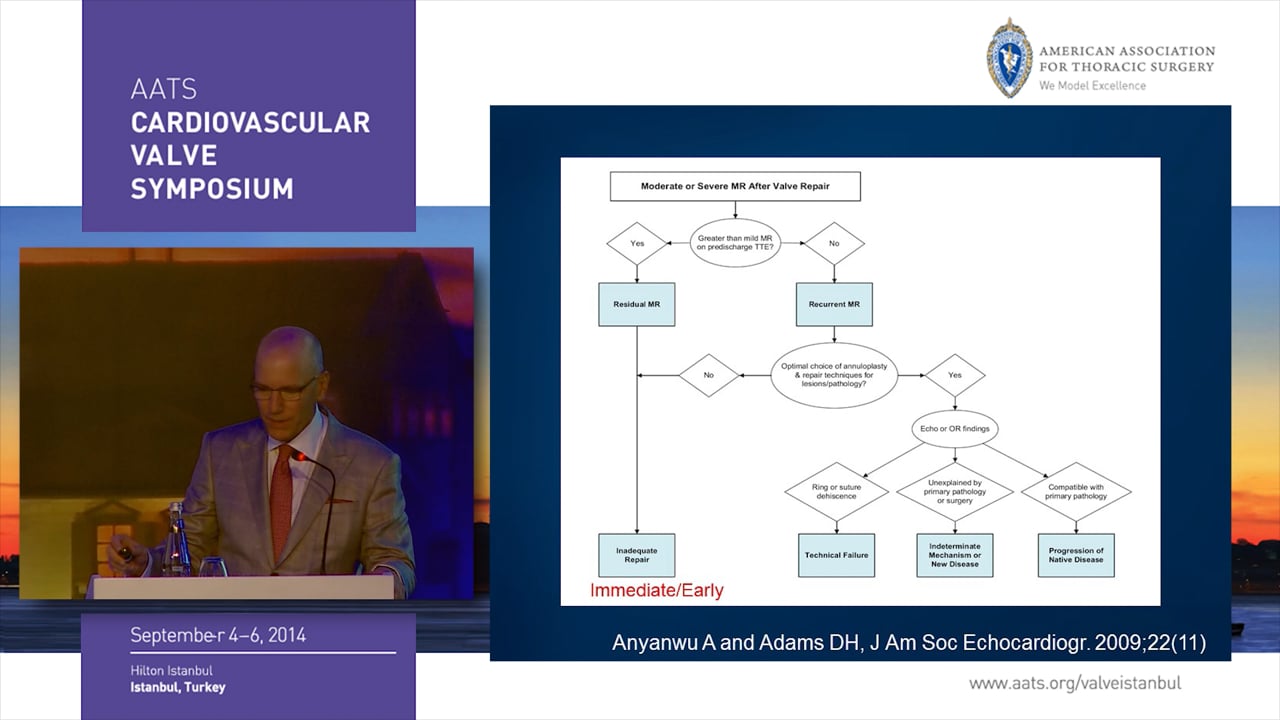
To summarize, I think we are going to go in 2008 and how we can continue to resolve this mitral valve quandary. The first is real time 3D TEE, I had the pleasure of writing a paper about the Imager and Surgical Anatomy with Roberta Lang. It will come out next year in JACC Imaging and we really highlighted, I think, in a very succinct way how 3-D echo is going to help the imager differentiate disease and match lesions with surgical expertise. Here you see how simple it really is. Here is the P3 prolapse from single chordal rupture in a patient with fibroelastic deficiency, and this is the surgeons view; aortic valve here, posterior leaflet here, P3, and posterior commissure, very straightforward. So I think that is one of the things to watch in 2008, how that is going to impact referral. The next question going to be asked is actually also coming out in an editorial we wrote about another paper looking at etiology of disease, and I think we all have to start thinking more about differences in degenerative valve repair. Look at this simple prolapse versus the complex prolapse of Barlow’s and also the repair of simple triangular resection versus a detachment and repositioning of the entire posterior leaflet. Why would we expect those patients to behave the same. I think we all have to start studying more to understand it and this is why; because patients are failing with mitral valve repair and you have all seen it and I have patients fail. We do not want to have patients fail here like the one I showed you before that we needed to re-repair but we are all seeing patients that are developing a recurrence of mitral regurgitation that was introduced by Flameng in Circulation in 2003 and followed by Tirone David in 2005 where you can see the posterior leaflet prolapse does pretty well but when we get into more complex forms of Barlow’s disease, bileaflet or anterior leaflet prolapse, these patients; they are not freedom from re-operation, it is freedom from recurrent three or four plus mitral regurgitation. So we have to keep improving our mitral valve repair techniques.
I want to show you pictures of my own cases from four years ago, anterior leaflet, posterior leaflet and today. You see the symmetry of the closure line here, perfect symmetry and here you see the posterior leaflet. The valve is competent. If you just turn the color on, you are going to be happy but if I show this picture today in an expert mitral valve meeting, I would not expect to show this example because this is not a very good result. You do not have symmetry. All of this posterior leaflet should be underneath this edge to promote closure and in fact one of the things we did this year was we designed a study that we call the ‘ink test’ to help us in the operating room be able to judge how much coaptation we have below the closure line when the ventricle is filled with saline, so that we can optimize that and we do not have to wait for the postoperative echo to understand how much of the leaflet coapts.
One of the things I have noticed is; mitral valve surgery is just like other parts from your body, you scar a little bit. The valves shrink a little bit. I am sure that is one of the mechanisms so one of the key points this year in mitral valve repair is optimizing this closure line and I think you are going to see a lot of data published about that over the next few years.
So I am going to finish with another quote from this summary that Bernadine Healey wrote about the mitral valve question today, “This is fixable. Surgeons who offer patients only valve replacement, because that is what they do well, must think again, so must cardiologists reluctant to refer patients elsewhere for care, and insurance providers, and we know there are a lot of them, who make doctors and patients jump through hoops for treatments outside of their networks cannot fight clear cut practice guidelines.”
Thank you very much for your attention.